Mark's #39 - The Tipping Point: How Little Things Can Make A Big Difference by Malcolm Gladwell

Earlier this year I discovered and read Malcolm Gladwell's book Outliers, which I really enjoyed.  I have since purchased two more books by Gladwell, including this one.  As a writer, he has a way of looking at the world, digging deep into the ordinary, and drawing out some extraordinary conclusions and applications.  Like Outliers, Gladwell challenges traditional notions of how the world works, and in a compelling fashion, re-interprets the world as we know it.

In short, in this book, Gladwell attempts to explain how certain things "tip" to become social epidemics. For example, how is it that Paul Revere was so effective in spreading the word about the oncoming British, whereas other riders with the exact same message were unable to do so? Answer: Revere was what Gladwell calls both a connector (someone who knew a lot of people) and a maven (someone with expert knowledge - in this case, knowledge about the British).  Or how is it that fashion trends take off? How do books become best sellers?  Why has there been a rise in school shootings?  Why is Sesame Street so effective, and why is Blues Clues even more effective? Why did crime substantially drop on New York City Subways in the early 90's? What's the link between suicides in the South Pacific and teenage cigarette smoking?

Gladwell argues, and encourages others to think about, that there are often very small catalysts that cause various epidemics to 'tip'.  For example, the dramatic rise in school shootings 'tipped' after the Columbine shootings in my home town of Littleton, Colorado, as other teens connected to the event, almost like they caught a a virus.

Or take the drop in crime on the NYC metro. The 'tipping point for this decline was when new management of the system made it a top priority to crack down on and eliminate graffiti on the cars... to see why, you'll need to read the book.

At times this book did feel a bit disjointed, though Gladwell throws in enough interesting illustrations to keep the reader engaged.  Also, though there was some, I would have liked to see a bit more application for thinking about creating epidemics ourselves, rather than reading example after example of how these things happened in the past. Because of this, I did not find this book quite as engaging as I did  Outliers.

As I reflect on the book, I wonder what changes I could make to create positive change in my world.  What small changes could you make in your life, career, community, or church that might serve as a 'Tipping Point' for an avalanche of change?

Ron’s #33: Demonic by Ann Coulter

I know I’m going to catch flack for this one, but I am happy to say that I enjoy a dose of Ann Coulter once in awhile. She’s an intelligent woman who is a good writer, and she is often pretty funny. I think her jokes/insults go further than I would go at times, but it is difficult to disagree with her conclusions. Lots of folks say terrible mean things about her, but it is not about her major points in politics. In fact, when I told a friend that I was reading this, his first comment was, “She is so hateful.” I disagree with him, but it does show a persuasive opinion about her and other outspoken conservatives.

I’ll be brief on this book. I really enjoyed it. Coulter’s premise is that unruly mobs control and guide liberal politics in the world, whether through violent protests, ad hominem attacks, or fear tactics to force people in “politically correct” line. She offers an excellent overview of both the American Revolution and the French Revolution. The first was led by ideas, the second was led by knives and axes. Even the most anti-Coulter folks would enjoy these summaries. She continues in showing how violent mob protests are from liberals, almost never conservatives. When conservatives are violent, conservatives condemn them. Not so with liberals. Smashing windows, booing speakers, forcing people to leave for their safety are all praised as “power to the people” movements.

If you enjoy political discussions, this is a good addition. In fact, I would read your favorite liberal treaty if you read this one. Stop just blasting Ann Coulter without knowing anything about her work.

I’ll end this review with a few quotations that I highlighted because they were insightful or funny or both.

Liberals were more sympathetic to Islamic terrorists than they were toward President Bush.

Dissent is patriotic only when a Republican is president, and we must have “respect for the office” only when a Democrat is president.

Jimmy Carter was unable to comment because he was in Pyongyang with Habitat for Humanity building Kim Il Sung a new missile silo.

This country’s founders were strongly against the mob—as are today’s Tea Party patriots. Noticeably, modern Tea Partiers haven’t engaged in one iota of property destruction, in contradistinction to nearly any gathering of liberals.

Liberals hate the idea of a revolution by gentlemen, which is why they celebrate hairy, foul-smelling revolutionaries like Che Guevara, Fidel Castro, and Susan Sarandon.

The mob demands total chaos in sexual traditions, morals, and decorum—but fascistic uniformity when it comes to opinions.

Liberals loathe conservative women beyond reason, perceiving them as the natural keepers of religious faith and morality.

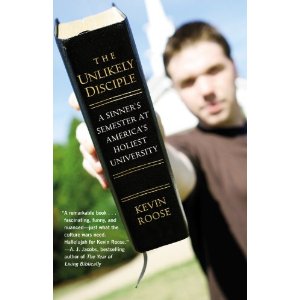
David's #1 The Unlikely Disciple: A Sinner's Semester at America's Holiest University By Kevin Roose

51K60TT-O+L._SL500_AA300_.jpg
While his classmates are studying abroad, far left leaning Brown University student Kevin Roose also decides to immerse himself in a new world.  He spends a semester undercover at Liberty University, studying the mysterious evangelical Christians culture.
 I expected a much harsher, judgmental perspective.  Despite his background, he goes into the journey with an open mind, and he does a pretty good job of maintaining it.  He does not hold back on his criticisms but also admittedly experiences far less hate and bigotry than he expected and much more love and compassion.  He examines and comments on all aspects of the university and the people around him, from the quality of professors and education and the school’s uber-strict rule book,  to his personal relationships and interactions, both good and bad, that he experiences.  He even spends spring break on a mission trip at Daytona beach.
It was interesting to watch as his reflections on his new surroundings spur on introspection.  While his experience did not result in a world view makeover, his mind was definitely opened for the better.  At a minimum his witty writing keeps the book entertaining.  A fun, interesting read regardless of your views.

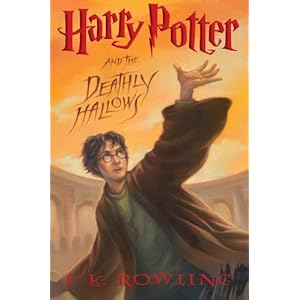
JRF's #27 - Harry Potter and the Deathly Hallows by R.K. Rowling

I'm not a Harry Potter evangelist.  If your conscience won't allow you to read or watch Harry Potter, I have nothing against you.   But if it means anything, I can honestly say that at no point in reading the books or watching the movies was I actually tempted to try to ride a broom, free any house elves, wield a wand or change my appearance using polyjuice potion.  Instead, I was uplifted by a great and gripping story, the center of which lifts up sacrificial love.
If you've read the books you know they are good and why they are (unless you are Ron, who is weird).  If you haven't read the books due to your convictions, I understand and appreciate your stance.  That's all I'll say about that.

What I really want to use this post for is to propogate my foolproof method of enjoying books that have been made into movies.  The secret?  ALWAYS watch the movie FIRST.  It is a well known fact that however great a movie is, the book will always surpass it.  The Harry Potter movies are great movies and have been impressively and adequately adapted from the books.  But there is simply no way that 800+ page books can be translated into a 2 hour movie.  More importantly, the details of relationships, thoughts, emotions...etc that make a book so enrapturing cannot ever be as effectively communicated on screen.  I always left the HP movies with a smile but a slightly confused smile.  I enjoyed getting from Point A to Point B to Point C, but often was confused on how I got there.  Many times there seemed to be holes in the plot or logic of the film.  However, once I read the books, Rowling made the journey from Point A to Point C (with a few side jaunts to points i and ii) entirely logical and smooth.

Bottom line: if you read the book then watch the movie (and i am talking about any book to movie, not just HP) 9 times out of 10 you will be disappointed with the movie.  If you watch the movie then read the book, you will be able to appreciate the movie and the appreciation of the story can only grow as you then read the book.

The world of literature and film is better because of J.K. Rowling's imaginative story and it has been a fun journey watching and reading it.

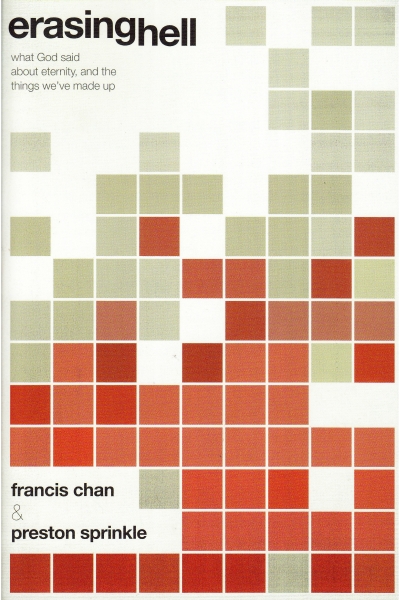
Ron’s #32: Erasing Hell by Francis Chan and Preston Sprinkle

Rob Bell’s Love Wins made quite a stir in March as it proposes that no one will go to hell, and that all will, in the end, go to heaven. Because of God’s love, the salvation of all mankind is a reason to rejoice that “love wins.” Sounds like a good story, but the problem is that Jesus spoke of hell often, and he seems to disagree with Rob Bell’s premise. Between Jesus and Rob Bell, I’ll choose Jesus, even if Bell has cooler hipster glasses.

The doctrine of hell is not one that excites me and brings me joy. In fact, I try to avoid thinking about it when I can. If Jesus is telling the truth when he says that he is the way, the truth, and the life and that no man may go to the Father except though him, that means there will be others—many others—outside of the Father in hell. This is troubling and motivating.

I’m usually not interested in books that spring up to counter or critique another book, and I was a little shy about reading this, thinking that it would attack Rob Bell on his views of non-hell. Gladly, I was wrong in my fears. While this book addresses Rob Bell a few times, the content is more on the bigger debate on hell, its presence, its purpose, and its punishment length. It’s a good cross between being scholarly-technical and clear for the average reader (like me). Erasing Hell is not about knocking Rob Bell down, or even in revealing that our neighbors will burn in everlasting fire like some sideshow preacher; rather, it is a sobering look at a doctrine that is in the Bible, discussed by Jesus, preached by Paul. Shouldn’t we look into it ourselves to see if these things are true?

If it is true, Chan and Sprinkle contend, this should change the way we speak, think, and pray.

Here is an excellent quotation that I think captures the essence of the book:

“This is not just about doctrine; it’s about destinies. And if you are reading this book and wrestling with what the Bible says about hell, you cannot let this be a mere academic exercise.  You must let Jesus’ very real teaching on hell sober you up.  You must let Jesus’ words reconfigure the way you live, the way you talk, and the way you see the world and the people around you.”

This book helped me to see this a little better.


(Post script) I just read Mark’s review after finishing mine, and they are remarkable similar, even down to the one quotation. This goes to show why we are such good friends! He is a bit better because he has a video. Mark Wins.)

JRF's #26 - Called to Lead by John MacArthur

This book, formerly published under the somewhat pompous title - "The Book on Leadership", examines the life of Paul and draws 26 leadership lessons from his example.

I don't know if you are ever tempted to skip the Introduction to a book and jump right in on Chapter One, but if you read this book make sure not to neglect the Introduction.  In it, MacArthur defines leadership Biblically, which is quite another thing entirely from Worldly leadership.   That isn't to say that those who are faithful leaders in the Biblical sense will not or can not be leaders in the World, however the means, motivations, and power behind that leadership will be drastically different from those who do no follow Christ.

I also appreciated how MacArthur points out in the introduction that all Christians are called to be leaders in some sphere or another.  At a basic level all Christians are called to be leaders because all Christians are called by Jesus to be "teaching them to observe all that I have commanded you" (Matt 28:20).  To be a Christian is to be a teacher.  To be a teacher is to be a leader.  This book is not just for pastors, or men, or CEO's...it is for all who seek to be faithful to lead in whatever venue and relationships God has given you.

The first third of the book (and most enjoyable) draws leadership principles from the harrowing account of Paul's journey to Rome as a prisoner and the subsequent shipwreck recorded in the last chapters of Acts.  Seeing as how he was in chains, Paul was the least likely person to lead anyone, let alone an entire ship's crew, her captain, and the Roman Centurion who was charged with keeping Paul in chains.

The second third looks at Paul's leadership of the Corinthian church, as recorded in II Corinthians.  Here the church he had poured his life out for was falling away from him, necessitating both a firm, direct, yet loving rebuke from the apostle as well as a harsh and fierce offensive against the false teachers that were leading the church astray.

The last third of the book examines Paul's final letter, II Timothy, and discusses how a leader should aim to remain qualified to lead and finish his race with integrity.

This book was definitely challenging to me and I ask for your prayers as I seek by God's grace to live out these principles in any and all spheres of influence God places me in.

the 26 Leadership Principles:

  1. A leader is trustworthy
  2. A leader takes the initiative
  3. A leader uses good judgement
  4. A leader speaks with authority
  5. A leader strengthens others
  6. A leader is optimistic and enthusiastic
  7. A leader never compromises the absolutes
  8. A leader focuses on objectives, not obstacles
  9. A leader empowers by example
  10. A leader cultivates loyalty
  11. A leader has empathy for others
  12. A leader keeps a clear conscience
  13. A leader is definite and decisive
  14. A leader knows when to change his mind
  15. A leader does not abuse his authority
  16. A leader doesn't abdicate his role in the face of opposition
  17. A leader is sure of his calling
  18. A leader knows his own limitations
  19. A leader is resilient
  20. A leader is passionate
  21. A leader is courageous
  22. A leader is discerning
  23. A leader is disciplined
  24. A leader is energetic
  25. A leader knows how to delegate
  26. A leader is Christlike