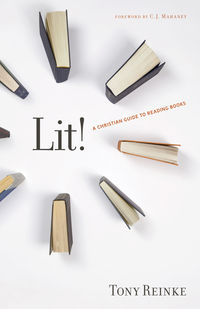
Ron’s #38: Lit! by Tony Reinke

“Almost all men are infected with the disease of desiring useless knowledge. It is of great importance that we should be told what is necessary for us to know, and what the Lord desires us to contemplate, above and below, on the right hand and on the left, before and behind.

The love of Christ is held out to us as the subject which ought to occupy our daily and nightly meditations, and in which we ought to be wholly plunged.” –John Calvin, as quoted in Lit! p. 96.

I love books on the power and importance of reading. I saw Lit! reviewed somewhere, and I thought it sounded like something I’d like to read. The subtitle tempered my eagerness to read the book (“A Christian Guide to Reading Books”), but I still bought it, and I was glad that I did.

Tony Reinke focuses on the importance of reading, how to choose books, and how to read books. It is NOT, as the subtitle suggests, a book list of terrible yet “religious” books to read. Rather, he begins with the premise that Christians are to be people of the Word and of words. God reveals Himself through the written word, and we ought to strive to understand what words mean.

I liked his list of the six priorities that decide what books to read:

1. Reading Scripture

2. Reading to know and delight in Christ

3. Reading to kindle spiritual reflection

4. Reading to initiate personal change

5. Reading to pursue vocational excellence

6. Reading to enjoy a good story

He offers ways to increase our reading time, along with a small treaty on how the Internet cripple book reading (chapter 11). Given my heavy reading recently on the problems with my time on the Internet, I especially enjoyed that chapter. He and I seem to be kindred spirits on this issue. Reinke even realizes that his Kindle often interferes with reading time. This is something that I recently noticed in myself, and I have backed off from reading books on screens when a physical book is available.

I highly recommend this book is you want to read more, read better, or read with a larger purpose. I heavily marked my copy of this book because it will be one that I’ll want to review when I forget.

As the ultimate Book in authority and power states, “So, whether you eat or drink [or read], or whatever you do, do all to the glory of God” (1 Cor 10:31). Tony Reinke’s Lit! helped me to see how this is done.

Mark's #47 - The Devil in the White City: Murder, Magic, and Madness at the Fair that Changed America by Erik Larson

Earlier this year, I read Erik Larson's book In The Garden of Beasts. It was with that book that I experienced Larson's ability to bring the details of history alive.  In The Devil in the White City, Larson does the same thing through his meticulous research and engaging prose.

This book feels like two books sort of smashed together as one.  Sure there are significant overlaps in time and geography, but for the most part I was alternately mildly amused and creeped out.  I was amused by the details, planning, politics, architecture, and accomplishments of the World's Fair of 1893 in Chicago.  These descriptions of the lives, struggles, technological advancements, inventions, and lasting legacies born out of such a grand event was. To mention a few; the Ferris Wheel, Shredded Wheat, the Pledge of Allegiance, and the first widespread use of AC electrical current.

I was creeped out by the other portions of the book which follow the life of America's first true serial killer H.H. Holmes (born Herman Webster Mudgett).  Here was a fairly intelligent, persuasive, handsome man who posed as a doctor and an entrepreneur.  His gentle and persuasive manner lured dozens, perhaps hundreds of mostly young single women.  As he took advantage of the booming business opportunities the Fair provided, Holmes ran both a hotel and a pharmacy in a large building near the Fair grounds.  Using his medical knowledge, along with various gasses and acids, Holmes took great pleasure in murdering people.

However, I did not take great pleasure in reading about his murders, or the seemingly endless details of the fair grounds and its buildings.

Ron’s #37: Short Cuts by Raymond Carver

Raymond Carver is one of my favorite short story writers. His short, terse prose paints a world full of broken people trying to fix broken lives. I first read a Carver short story in a literature class at Clackamas Community College (still the best lit class I’ve taken) where we read “The Third Thing that Killed My Father.” I knew there was something different about his writing, and I’ve loved him ever since. I think that if I were a writer, I’d want to emulate his style. Simple writing, uncomplicated story, believable characters.

Short Cuts is not an original collection. It was culled together for Robert Altman’s 1993 film of the same name. He took a sampling of stories for the movie, and this collection was released. While they are not my favorite Carver selections overall, there are gems here. My favorite in this collection is “A Small, Good Thing.” It tells the story of a couple dealing with the sudden death of their son on his birthday, finding solace in the local baker.

Many of Carver’s characters are people at the end of their moral rope, hopeless in marriage, work, or just life overall. While some may consider this depressing subject matter, Carver is able to show the need for grace in our lives. These people are people just like us: broken, imperfected, confused, in need of grace and hope.

If you are interested in exploring more of Raymond Carver, I suggest buying his collection, What We Talk about When We Talk about Love. In that book, you can read “The Third Thing that Killed My Father” and “Everything Stuck to Him.” The latter is one of my favorite stories of all short stories. I teach it almost every year to Juniors, and it still touches me as it did when I first read it.

Recently, Will Ferrell starred in a film based on a Raymond Carver short story, Everything Must Go. While it is not a good reflection of Carver’s minimalist style, it offers a sampling of the people who live in Carver’s universe.

httpv://www.youtube.com/watch?v=d2kXUY7SmkE

Mark's #46 - Steve Jobs by Walter Isaacson

"The people who are crazy enough to think they can change the world are the ones who do." - Apple's "Think Different" commercial, 1997

As I write this review on my iMac, reading my notes (and the book) on my iPad, and receiving texts from friends and family on my iPhone (all of which I love to use), it is obvious that Steve Jobs has in many ways affected my own life.   Therefore, this book is not only a biography of our generation's Edison, but in some ways it reads as a personal biography of my own life, as Apple's various products and design philosophies of art intersecting technology have shaped my own thinking in many ways.

To be clear, Steve Jobs is not a god, or an angel, or someone to be worshipped.   Isaacson's honest portrayal of Jobs shows that, like all humans, he was deeply flawed, misguided, self-righteous, prideful, and totally depraved  - though Steve's flaws often seem to be magnified.  And yet, Job's life and accomplishments also show a measure of God's common grace still manifested in the imago Dei.  As such, I will put the remainder of  this review in the following categories: The Good, The Bad, and The Ugly (but in reverse order)

THE UGLY

Steve Jobs was often brutal, vindictive, and ugly in dealing with people.  He was demanding and arrogant with almost everybody... whether it was the local waitress or his wife.   Though a genius, he spent much of the early 70's at hippie communes dropping acid, or traveling to India to study under a guru.  Paradoxically, Steve embraced Zen Buddhism which emphasizes detachment from the world, while at the same time seeking to make products and profits that do the exact opposite.

THE BAD

I guess this goes along with the ugly, but there are plenty of bad aspects of Job's life and personality as well.   The book details many people who have been wounded and betrayed by Jobs sharp tongue, deceit, and meanness.   It seems Jobs never developed a filter for his emotions or his mouth.  At times he would cry, scream, or stare coldly and unblinkingly at people as ways to manipulate them.   Jobs had what many labeled a "reality distortion field" around him.  He had the ability to distort reality and even get others to buy in to that distorted reality.  Jobs saw himself as enlightened - on a higher plane than almost every other person.  As such, he deemed it his right and responsibility to stand in a place of judgment of almost all others - this was his worldview.  Unfortunately for jobs, this is not reality. Only God is God, and God will always humble the proud.

THE GOOD 

In spite of the ugly and the bad, there is much good that has come out of Steve Job's life.  Certainly the products he worked so diligently to produce, but there's much more behind the products that I was able to personally benefit from.  Jobs wanted to do only a very few things well.  Apple could have produced a ton of consumer products, but then Apple would just be a reiteration of Sony or Google.  Instead, Jobs wanted to do one or two things 'insanely great' - and he did.   His hard personality and reality distortion field, would at times work well toward this end.  Jobs was able to get people to achieve personal levels of success that they did not believe was possible .

So often we are tempted to do a bunch of different things in our lives, without ever really doing any of them great.  If we were to evaluate our lives with the same level of scrutiny Jobs evaluated his potential products and focussing in like a laser on the one or two key things, I believe we would be better for it as individuals and as a society.

JRF's # 36 - A Quiet Reality By Emilio Marrero

In this memoir, Chaplain Emilio Marrero recounts his experiences with the 1st Marine Expeditionary Force at the onset of Operation Iraqi Freedom.  Following the invasion his unit set up operations at Sadaam's former palace at Babylon.   Marrero soon found himself leading efforts to keep the Babylon Museum and the ruins of the ancient city from getting completely looted in the post-invasion chaos.  Eventually he was dubbed the unofficial "Mayor of Babylon" by the locals because of his influence, compassionate advocacy for the locals, and wise negotiating between the mission of the U.S. Military, the needs and desires of the local Iraqis, the demands of politicians, and the needs of a frail but immensely important archaeological site.

As a fairly new Chaplain myself, this account was both encouraging and instructive.  Marrero's ministry in Iraq is a great example of immense potential for influence - politically and spiritually - that a creative, motivated, and Christ-led chaplain has.  At many times I found myself stoping and jotting down ideas for my own ministry that were inspired by Marrero's initiatives.   Other times I felt my heart convicted by the determination and passion with which he pursued people and initiated ministries from the ground up.  Too often have I let the discouragements and obstacles of military ministry drown out the many unique and powerful opportunities for Gospel influence.  It was also a great encouragement to look at the Chaplain Corps through the eyes of a Chaplain who genuinely loves Jesus and people and kept the Main thing the Main thing.

I only had a few criticisms of the book: (1) ironically it seemed at times that Marrero's quasi-Arminian theology was at odds with the major theme of the book - God's quiet, behind-the-scenes sovereignty and (2) the book could have used another round of proof-reading as there were a small amount of minor typos scattered about.

Throughout the book Marrero uses the phrase "quiet reality" to describe the intangible experiences and forces behind the types of things that make the headlines of newspapers, military reports, and facebook statuses (statusi?).  The Ultimate "Quiet Reality" of Emilio Marrero's story is that God is and will continue to be working through the events of the Iraqi Freedom both in the lives of the invaders/liberators and conquered/liberated.

This is an excellent book for anyone who is interested in Military Ministry, Biblical Archaeology, or just likes a good story about the Grace and power of God shown in and through a willing servant.

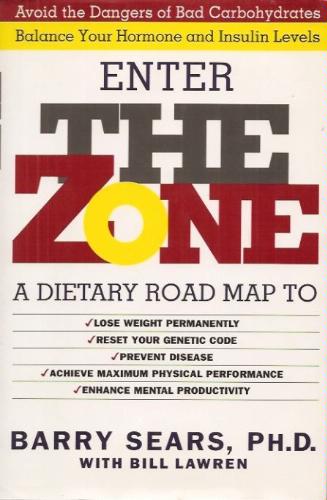
David's #3 - Enter The Zone By Dr. Barry Sears

This is the first of what will probably turn out to be many book reviews on nutrition and fitness related topics. It is one of my favorite subjects. Most people that have heard of "The Zone", will think that this is a diet book. And most people who think of diet, think weight loss. "How do I shed that extra weight and get those six pack abs or flat stomach that is going to make me look good on the beach?" I admit that weight loss is a huge marketing point of "The Zone" books, this one included, and Zone nutritional products. But this book is so much more than a diet book. Dr. Sears argues that food is like a drug and that everything we eat has a hormonal effect on our bodies.Those hormones can do amazing things, both good and bad. "The Zone" is all about the proportion of carbohydrates, protein, and fat in the meals we eat. The Zone diet breaks down food into blocks. For example:1 oz of chicken is a block of protein, 4 oz of wine is a a block of carbohydrates(or a whole head of iceberg lettuce, you choose), and 1/3 of a teaspoon of olive oil is 1 block of fat. Based on your body weight and composition, each person should eat X number of a blocks per day, broken up into equally proportioned meals. Dr. Sears covers a wide range of topics including how to eat properly to lose weight and look the way we want. My particular interest was in how to improve energy levels, sleep quality, and athletic performance through diet. As well, I found out how food effects acne, chronic fatigue, depression, and blood pressure? He even explains how nutrition can greatly decrease one's risk of heart disease, cancer, and diabetes( or keep it under control if you have it), without the use of drugs. His solution to all of these questions is the same: properly proportioned, "Zone" favorable meals.

Sears backs up his claims with hard scientific studies. Although these can be technically detailed, the outcome is summarized in basic terms and real results. He has had greats success in his extensive work with overweight subjects, the Stanford swim team, and the Los Angeles Rams(its an older book). Regardless of technical expertise, anyone who reads this book will understand the basics of how to enter "The Zone" and why you would want to. Sears likes to emphasize the fact that no food is prohibited on The Zone diet, just quantities. That being said, not all food is created equally. Not all types of fruits and vegetables are as good for you as you might think. For example, a bagel, a glass of O.J. and a banana is not the nutritious start to your day that you might think. In fact, it's a blood sugar nightmare.

The knowledge from this book will help the astute reader use food to not only lose weight but to truly improve the quality of life today and in the long term. It will show you how to "Enter The Zone" and stay there.